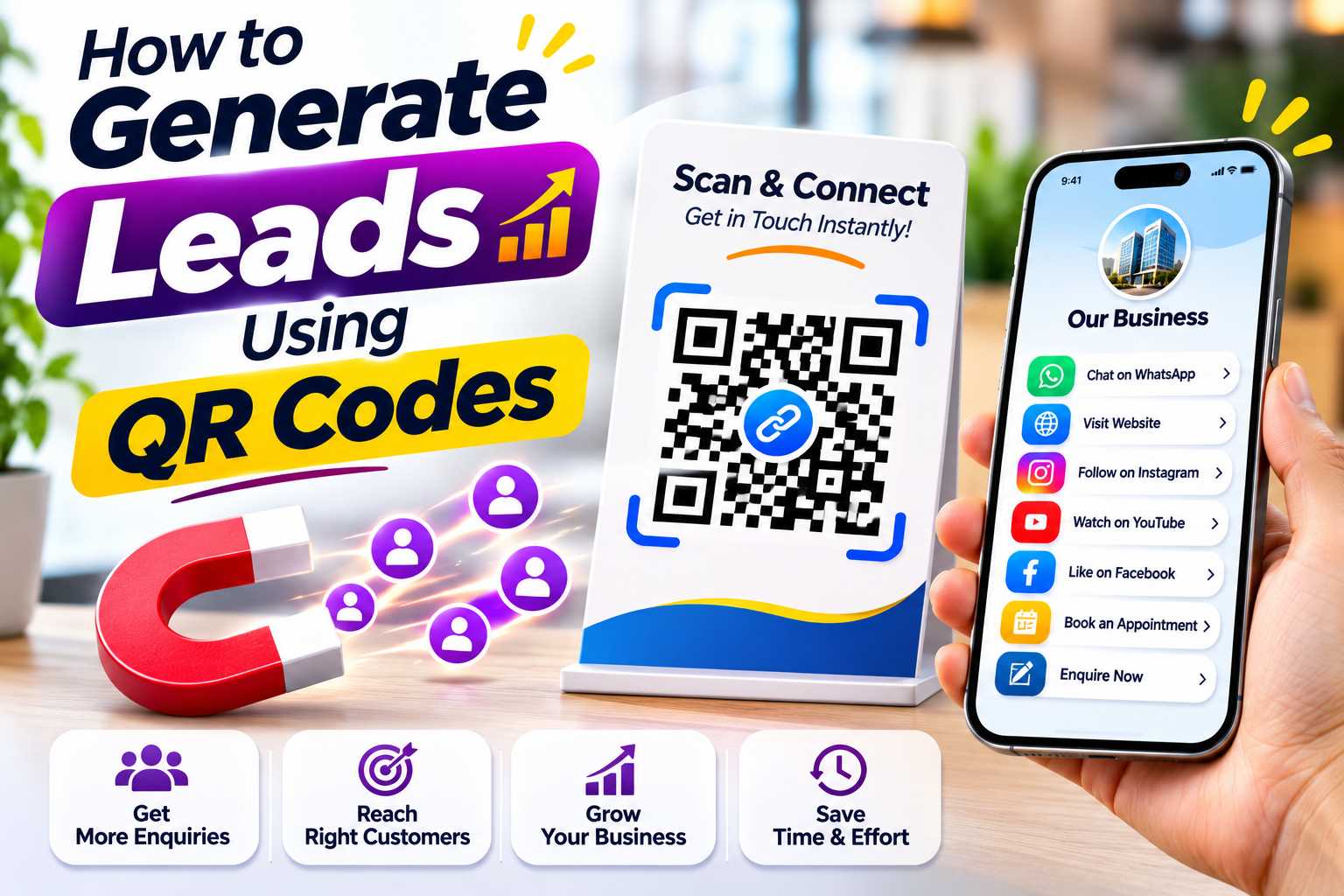
QR codes can do much more than open a website. When used strategically, they can help businesses generate leads by connecting customers directly to WhatsApp, enquiry forms, digital business cards, landing pages, product catalogues, appointment booking pages and other high-intent actions. A well-placed QR code can turn a poster, visiting card, product package, brochure, storefront or event display into a direct lead-generation channel.
For small businesses, freelancers, consultants, retailers and service providers, QR codes can reduce the number of steps customers need to take before contacting the business. Instead of asking someone to search for a website, save a number or type an email address, one scan can take them directly to the next action. This guide explains how to generate leads using QR codes, where to place them, what destinations work best and how to improve scan-to-enquiry conversions.
How to Generate Leads Using QR Codes
Lead generation is the process of turning interested people into potential customers who provide a way for the business to continue the conversation. This may happen through a WhatsApp message, enquiry form, phone call, appointment request, email submission or another direct action.
QR codes can make this process faster because they connect offline customer interest with digital lead-generation channels.
For example, someone may see a printed poster outside a store, notice a product package, receive a visiting card or attend an exhibition. Instead of asking that person to manually search for the business online, a QR code can take them directly to the next step.
The effectiveness of a QR code therefore depends less on the code itself and more on what happens after the scan.
What Makes a QR Code a Lead-Generation Tool?
A QR code becomes useful for lead generation when it connects users to a clear and relevant action.
If the code simply opens a homepage with no obvious next step, many visitors may leave without contacting the business.
A better approach is to connect the QR code to a focused destination that matches the customer's intent.
Points
A lead-generation QR code can direct users to:
WhatsApp enquiry
Contact form
Callback request
Appointment booking
Free consultation form
Product enquiry page
Digital business card
Multi-link business profile
Downloadable brochure
Demo request
Quote request
Event registration
Newsletter signup
Special offer page
One Scan Should Lead to One Clear Next Step
Customers are more likely to respond when the action after scanning is obvious.
If the QR code is placed on a service poster, the next step may be Book a Free Consultation. If it appears on product packaging, the action could be Enquire on WhatsApp. At an exhibition, it may be Save Our Digital Business Card or Request a Demo.
The QR destination should match the context in which the customer discovers the code.
1. WhatsApp Lead Generation QR Code
WhatsApp is one of the most direct lead-generation destinations for businesses that depend on conversations before completing a sale.
A QR code can direct customers to a WhatsApp chat so they do not need to manually save the phone number first.
This is useful for product enquiries, service requests, appointment questions, quotation requests and customer support.
Use a Pre-Filled WhatsApp Message
A predefined message can make the enquiry process even easier.
For example, instead of opening an empty chat, the message can begin with something relevant to the campaign, such as:
“Hi, I would like to know more about your services.”
For a product campaign, the message could refer to the specific product or offer.
This can also help the business understand which campaign generated the enquiry.
2. Lead Capture Form QR Code
A QR code can open a simple lead-generation form where customers submit details such as name, phone number, email address or service requirement.
The form should remain short. Asking for too much information before providing value can reduce completion rates.
Points
Useful form fields may include:
Name
Phone number
Email
Service required
Preferred contact time
Location
Short message
Ask Only for Information You Actually Need
For an initial enquiry, businesses usually do not need a long form containing many questions.
If a name, phone number and service requirement are enough to begin the sales conversation, keep the form limited to those fields.
Additional details can be collected later after the lead has shown stronger interest.
Turn One QR Code Into a Complete Business Contact Hub
A digital business card can be an effective QR destination because it gives customers several ways to connect with the business from one page.
Someone scanning the code may not be ready to complete an enquiry form immediately. They may first want to view the website, check Instagram, browse products or confirm the business location.
A digital business profile allows customers to choose their preferred path while keeping important contact actions easy to access.
Points
A lead-focused digital business card can include:
Call button
WhatsApp
Website
Instagram
Facebook
LinkedIn
Google Maps
Product catalogue
Services
Portfolio
Enquiry button
Appointment booking
Review links
Why Multi-Link QR Codes Can Improve Lead Opportunities
Different customers have different levels of intent.
One customer may be ready to WhatsApp immediately, while another may want to review services or social proof first.
A multi-link QR code gives both users a suitable path without requiring several separate QR codes.
For businesses using a platform such as VCRDS, one digital profile can act as the central point for calls, WhatsApp, websites, social media and other customer actions.
Place QR Codes Where Customer Interest Already Exists
QR code placement matters because people are more likely to scan when the code appears at a moment of genuine interest.
Simply placing a QR code everywhere does not automatically generate leads.
The best locations are places where customers are already looking at your products, services or business information.
Points
Effective placements include:
Visiting cards
Posters
Brochures
Flyers
Store counters
Reception desks
Product packaging
Product labels
Restaurant tables
Catalogues
Exhibition stalls
Event banners
Invoices
Delivery packages
Service vehicles
Appointment cards
Printed advertisements
Thank-you cards
QR Codes on Business Cards
A QR code on a business card can turn a simple networking interaction into a digital lead opportunity.
Instead of receiving the card and forgetting about it later, the recipient can scan immediately and open your digital business profile, WhatsApp, website or enquiry page.
This is particularly useful for sales professionals, consultants, real estate agents, freelancers and business owners.
QR Codes on Posters and Flyers
Posters and flyers can generate stronger responses when the QR code is connected to a specific campaign action.
For example, a promotional poster can use a message such as Scan to Get a Quote, Scan to Book Now or Scan to WhatsApp Us.
The QR code should support the headline rather than appearing as an unrelated design element.
Step 1: Decide the Lead Goal
Before generating the QR code, decide what counts as a successful lead.
For one campaign, the goal may be a WhatsApp message. For another, it may be an appointment request, phone call, form submission or catalogue enquiry.
A clear goal makes it easier to design the QR destination and measure performance.
Step 2: Create a Relevant Landing Experience
The destination should match the promise made next to the QR code.
If the poster says Scan for a Free Consultation, the QR code should open a consultation enquiry page or chat, not a generic homepage.
This consistency helps customers understand what to do next.
Step 3: Add a Strong Call to Action
A QR code by itself does not explain why someone should scan it.
Add short text that communicates the benefit.
Points
Lead-generation call-to-action ideas include:
Scan to Get a Free Quote
Scan to WhatsApp Us
Scan to Book an Appointment
Scan to Request a Callback
Scan to Get More Details
Scan to View Our Services
Scan to Claim the Offer
Scan to Contact Our Team
Scan to Start Your Enquiry
Step 4: Test the Complete Journey
Test more than whether the QR code scans.
Open the destination and complete the same action a customer would take.
Check whether the form submits correctly, WhatsApp opens the right number, calls work and confirmation messages are clear.
Make the Destination Mobile Friendly
Almost every QR scan happens on a smartphone, so the destination must work well on mobile devices.
Buttons should be easy to tap, text should be readable and forms should not require unnecessary zooming or scrolling.
A slow or poorly designed mobile page can cause users to leave before becoming a lead.
Reduce the Number of Steps
Every additional step creates another opportunity for the customer to abandon the process.
If the goal is a WhatsApp enquiry, take the customer directly to WhatsApp instead of sending them through several intermediate pages.
If a multi-link page is necessary, place the primary action prominently near the top.
Give Customers a Reason to Scan
People are more likely to scan when they understand the value they will receive.
The value could be information, convenience, a quotation, booking access, a product catalogue or another relevant benefit.
Avoid vague instructions such as Scan Here when a more specific message can communicate the result.
Build Trust After the Scan
The destination page should clearly show the business name, logo and relevant contact information.
Customers may hesitate to submit details if they are unsure whose page they have opened.
A recognizable business identity creates continuity between the printed marketing material and digital experience.
Use QR Codes According to Your Business Type
Different industries can use QR codes for different lead-generation goals.
The best campaign should match the customer's typical buying journey.
Points
Retail Stores:
Use QR codes for WhatsApp product enquiries, catalogues, offers and product availability.
Restaurants and Cafes:
Use QR codes for reservations, takeaway enquiries, menus and customer contact.
Salons and Beauty Businesses:
Use QR codes for appointment booking, WhatsApp enquiries and service packages.
Hotels and Homestays:
Use QR codes for booking enquiries, room information, WhatsApp and special packages.
Real Estate Professionals:
Use QR codes on property boards and brochures to collect property enquiries through WhatsApp or forms.
Consultants:
Use QR codes for free consultation booking, contact forms or digital business cards.
Freelancers:
Use QR codes to connect prospects with portfolios, enquiry forms and contact details.
Clinics and Service Businesses:
Use QR codes for appointment requests, callback enquiries and service information.
Training Institutes:
Use QR codes for course enquiries, brochure downloads and admission contact forms.
Create Different QR Campaigns for Different Customer Intent
A business does not have to use exactly the same destination for every campaign.
A product poster may use a WhatsApp enquiry QR code, while an exhibition card may use a digital business profile. A brochure may direct customers to a consultation form.
Matching each QR code to the campaign goal can produce a more relevant customer journey.
Measure More Than Just QR Code Scans
A high number of scans does not automatically mean the campaign is generating strong leads.
Businesses should look at what customers do after scanning.
For example, 500 scans with only two enquiries may indicate that the destination page or offer needs improvement.
Points
Useful metrics can include:
Total QR scans
Profile visits
WhatsApp clicks
Phone call clicks
Form submissions
Appointment requests
Product enquiries
Website visits
Conversion rate
Leads by campaign source
Use Separate Campaigns When You Need Better Attribution
If you place QR codes on several marketing materials, consider using campaign-specific tracking where your platform supports it.
For example, you may want to compare leads from a brochure, store poster and exhibition display.
This can help identify which offline marketing channels are generating the strongest customer response.
Track Lead Quality, Not Only Quantity
Ten relevant enquiries can be more valuable than one hundred accidental scans.
Businesses should evaluate whether QR-generated leads match their target customers and whether those leads progress into conversations, appointments, quotes or sales.
The goal is not simply to increase scanning. The goal is to generate meaningful business opportunities.
Avoid QR Campaigns That Create Friction
QR codes are designed to make customer interaction easier, but poor implementation can create unnecessary friction.
The physical design, QR destination and follow-up process all need to work together.
Points
Avoid:
QR codes that are too small
Blurry QR code images
Poor contrast
No call to action
Sending users to a generic homepage
Long lead forms
Asking for unnecessary personal information
Broken WhatsApp links
Incorrect contact numbers
Slow mobile landing pages
Too many competing buttons
No clear confirmation after form submission
Failing to follow up with leads
Printing without testing
Do Not Use the Same Message for Every Campaign
A QR code on a product package serves a different purpose from one displayed at an exhibition.
Use a relevant call to action and destination for each context.
Campaign-specific messaging makes it clearer why the user should scan and what they will receive afterward.
Connect Offline Customers With Your Official Online Presence
QR codes can help people move directly from offline marketing to your official digital business information.
Instead of asking customers to search for your company name manually, the QR code can take them to the correct business profile, website or enquiry page.
This helps maintain a consistent customer journey between physical and digital marketing.
AEO-Friendly Lead Information
Answer Engine Optimization focuses on making information clear and easy to understand.
After scanning, customers should be able to quickly answer questions such as:
What does this business offer?
How can I contact them?
Is WhatsApp available?
Can I request a quote?
Can I book an appointment?
Where is the business located?
How can I view products or services?
Clear button labels and concise business descriptions improve usability.
GEO-Friendly Local Lead Generation
Local businesses can use QR codes to connect physical marketing materials with accurate location information.
A restaurant, salon, clinic, hotel, shop or local service provider can include its correct business address, Maps link and relevant local contact options.
Geographic information should accurately represent the business location or service area rather than adding unrelated city names only for keyword targeting.
Combine Lead Generation With a Digital Business Profile
Not every visitor is ready to submit a form immediately. Some customers may first want to understand the business before making contact.
A multi-link digital profile can support both research and lead generation from one QR code.
For example, the page can include business information, website and social media links while keeping WhatsApp, call and enquiry buttons highly visible.
This allows users with different levels of purchase intent to continue the journey in the way that suits them.
Keep Lead Actions Prominent
When using a digital business card or multi-link page, do not hide the most valuable actions among many links.
Place high-intent options such as WhatsApp, Call Now, Get a Quote or Book Appointment near the top.
Supporting links such as social media or additional information can appear below.
This creates a balance between customer research and direct lead generation.