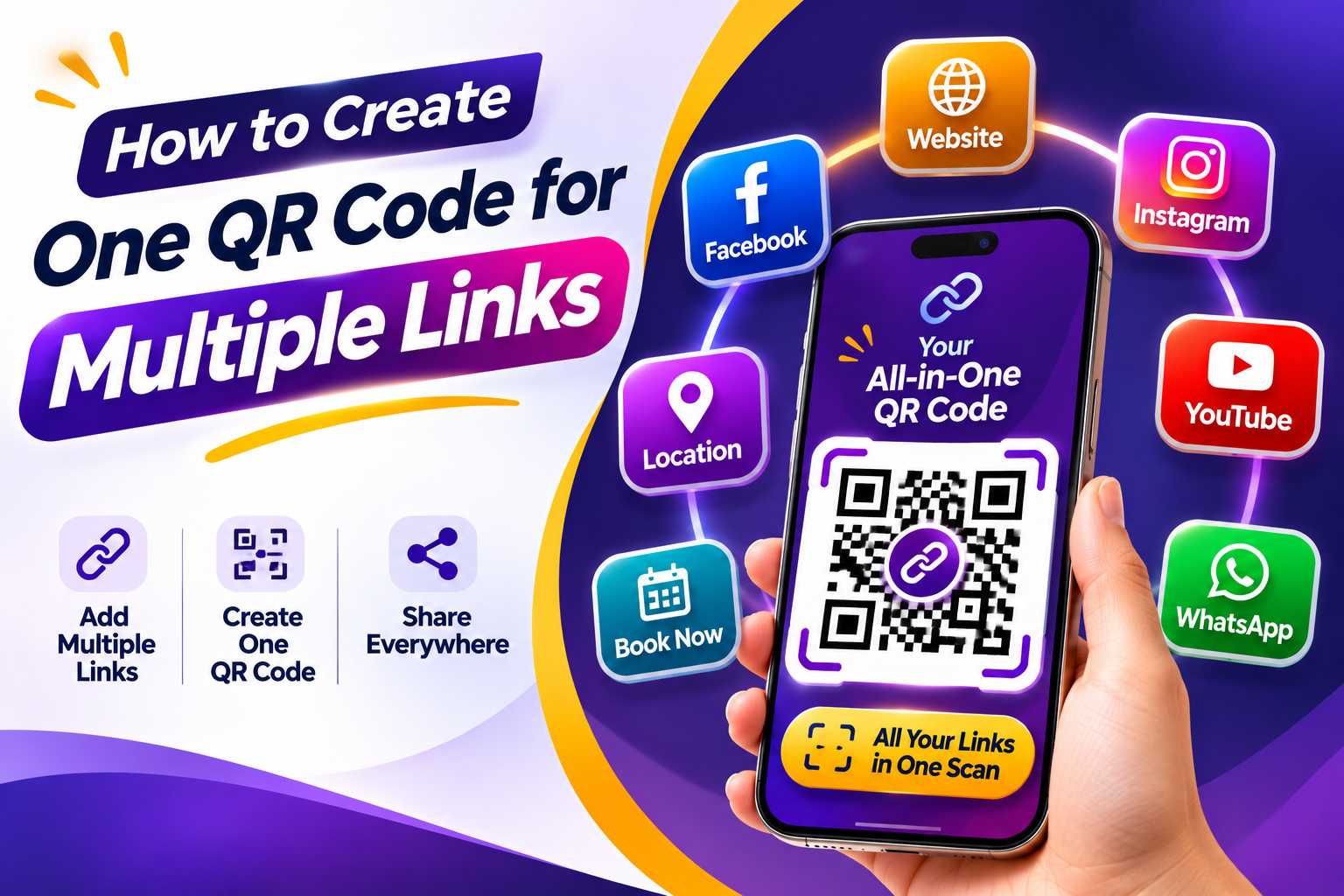
Creating one QR code for multiple links allows businesses and professionals to share WhatsApp, websites, Instagram, Facebook, LinkedIn, Google Maps, product catalogues and other digital destinations through a single scan. Instead of printing a separate QR code for every platform, you can connect one QR code to a mobile-friendly multi-link profile where customers choose the information or action they need.
This method is useful for business cards, posters, brochures, product packaging, shop counters, exhibitions and other marketing materials where space is limited. A properly organized multi-link QR profile can simplify customer communication, improve offline-to-online engagement and make it easier for people to call, message, visit, follow or enquire about your business.
How to Create One QR Code for Multiple Links
Businesses today often use several digital platforms to communicate with customers. A company may receive enquiries through WhatsApp, showcase products on Instagram, provide detailed information on its website and use Google Maps to help customers reach its physical location.
Sharing each of these destinations through separate QR codes can make a business card, poster or brochure crowded and difficult to understand.
One QR code for multiple links solves this problem by opening a central digital page containing all the important business destinations.
The customer scans only one QR code and then chooses the action they want to take.
How Can One QR Code Hold Multiple Links?
A QR code does not normally open several websites at exactly the same time. Instead, the QR code points to one mobile-friendly landing page or digital business profile.
That page contains multiple buttons or links.
For example, after scanning, the customer might see options such as:
WhatsApp Us
Call Now
Visit Our Website
Follow on Instagram
View Facebook
Connect on LinkedIn
Find Us on Google Maps
View Products
Book an Appointment
Send an Enquiry
The multi-link page acts as the central hub while the QR code acts as the gateway.
One Scan Gives Customers Several Choices
Different customers prefer different ways of interacting with businesses.
One customer may want to send a WhatsApp message immediately. Another may want to visit your website before contacting you. Someone else may simply need your location.
A multi-link QR profile allows all these users to begin from the same QR code while choosing their own next step.
Add the Business Links Customers Actually Need
A multi-link QR profile can contain many digital destinations, but adding too many unnecessary links can make the experience confusing.
The best approach is to focus on the platforms that help customers understand, contact or visit your business.
You can add:
Phone number
WhatsApp
Email
Business website
Instagram
Facebook
LinkedIn
YouTube
Google Maps
Google Reviews
Product catalogue
Service pages
Portfolio
Online store
Appointment booking
Enquiry form
Payment page
Restaurant menu
Downloadable brochure
Event registration
Can You Add WhatsApp, Instagram and Website Together?
Yes. These are among the most common links businesses combine in one multi-link profile.
WhatsApp can help customers make direct enquiries, Instagram can showcase visual content and the website can provide more detailed information about products, services or the company.
Instead of choosing only one destination, businesses can allow customers to select the platform that suits them.
Step 1: Collect Your Important Business Links
Start by preparing the URLs and contact details you want to share.
Check every destination before adding it to your profile. Outdated social media pages, incorrect phone numbers or broken website URLs can create a poor customer experience.
Prepare links such as:
Official website URL
WhatsApp contact
Instagram profile
Facebook page
LinkedIn profile
YouTube channel
Maps location
Review page
Product catalogue
Portfolio
Appointment page
Enquiry form
Step 2: Create a Multi-Link Digital Profile
Use a multi-link or digital business card platform to create one mobile-friendly page.
Add your business name, logo, contact information and a short description so customers immediately understand which business they have reached.
The page should look professional and be easy to use from a smartphone.
Step 3: Add and Organize Your Links
Insert your important links and arrange them according to customer priority.
Do not arrange links randomly.
If most enquiries come through WhatsApp, place WhatsApp near the top. If your business depends heavily on physical visits, make the Maps button easy to find.
Step 4: Generate the QR Code
Once your multi-link profile is complete, generate a QR code connected to the profile URL.
This QR code becomes the single access point for all your digital destinations.
You can then use it instead of creating several individual QR codes.
Step 5: Test Every Link
Scan the QR code from a smartphone and test the complete experience.
Confirm that every button works correctly and opens the intended destination.
Test WhatsApp, website links, social media, Maps, phone calls and enquiry forms before publishing or printing the QR code.
Place Important Customer Actions First
The order of links can affect how customers interact with your business.
High-intent actions such as WhatsApp, call, enquiry and appointment booking should normally appear before less important informational links when generating leads is the main objective.
For example, a local service business might use the following order:
WhatsApp
Call Now
Get a Quote
Services
Website
Google Maps
Instagram
A consultant may use a different structure depending on customer behaviour.
Use Clear Button Names
Customers should immediately understand what each button does.
Avoid vague labels such as Click Here or Open Link.
Use labels such as:
WhatsApp Us
Call Now
Visit Website
View Products
Get Directions
View Instagram
Book Appointment
Request a Quote
Send Enquiry
View Portfolio
Avoid Adding Every Available Link
A multi-link QR code is not useful simply because it contains a large number of links.
Too many options can distract users and reduce attention on your most important customer actions.
Only include active and useful platforms.
Create Cleaner Marketing Designs
Using a separate QR code for your website, WhatsApp, Instagram, Facebook and Maps can take up a large amount of space.
It may also confuse customers because they need to decide which code to scan.
One QR code keeps the design cleaner and gives customers one clear starting point.
Improve the Customer Experience
Customers only need to perform one action: scan the QR code.
After that, they can choose the platform or information they need.
This reduces unnecessary effort and provides a more organized way to interact with the business.
Use One Consistent QR Code Across Marketing
The same QR code can be placed across different marketing materials when it leads to the same central business profile.
This creates consistency between your visiting cards, brochures, packaging and shop displays.
Where the digital profile supports editing, individual links may also be updated while the main profile URL remains unchanged.
Use the QR Code Across Offline Marketing Materials
A multi-link QR code can be placed wherever customers need quick access to additional information about your business.
It is particularly useful on printed materials where displaying many URLs would be impractical.
You can use it on:
Business cards
Visiting cards
Posters
Flyers
Brochures
Product packaging
Product labels
Store counters
Reception desks
Banners
Restaurant tables
Menus
Product catalogues
Invoices
Exhibition stalls
Event displays
Service vehicles
Appointment cards
Thank-you cards
Use One QR Code on a Business Card
Business cards have limited space, which makes a multi-link QR code particularly useful.
Instead of printing several social media usernames and long URLs, you can keep your basic identity visible and use one QR code for the rest.
The customer can scan the card and access your complete digital profile.
Use It on Posters and Brochures
A poster can include a strong message followed by a clear QR call to action.
For example:
Scan to Call, WhatsApp & Explore Our Services
The customer scans once and receives several options instead of being restricted to one destination.
Use a Clear High-Quality QR Image
The QR code should remain sharp when printed.
Avoid taking screenshots of the code and enlarging them because this can reduce image quality.
Use a high-quality export and test it after placing it inside your final design.
Keep Strong Contrast
A QR code should be clearly distinguishable from its background.
Dark QR patterns on light backgrounds generally provide strong readability.
Avoid placing the code directly over complex photographs, textures or gradients that reduce contrast.
Leave Enough Clear Space
QR codes need an empty margin around the outer pattern.
Do not place text, icons or borders immediately against the QR code.
This clear area helps smartphone cameras recognize the code more reliably.
Test the Printed Version
A QR code that scans easily on a computer screen may not perform the same way when printed at a much smaller size.
Print a physical sample before producing large quantities of visiting cards, brochures or packaging.
Test it with multiple smartphones where possible.
Customize the Links Based on Your Business Type
Different industries should use different combinations of links based on what customers actually need.
Retail Stores:
Add WhatsApp, products, website, Instagram, Maps and customer reviews.
Restaurants and Cafes:
Add menu, reservation contact, WhatsApp, Maps, Instagram and reviews.
Salons:
Add WhatsApp, appointment booking, services, Instagram and location.
Hotels and Homestays:
Add booking enquiries, phone, WhatsApp, website, Maps and reviews.
Freelancers:
Add portfolio, email, website, LinkedIn and WhatsApp.
Consultants:
Add appointment booking, website, LinkedIn, email and contact information.
Real Estate Professionals:
Add calls, WhatsApp, property listings, portfolio and website.
Photographers and Designers:
Add portfolio, Instagram, website and enquiry links.
Service Businesses:
Add call, WhatsApp, service information, Maps and customer reviews.
Choose Links Based on Customer Intent
Businesses should think about why customers are scanning.
Someone scanning from a store counter may need contact information or social media, while someone scanning from a service advertisement may be ready to request a quotation.
Matching your multi-link profile with customer intent can make it more effective.
Both Can Point to a Multi-Link Page
A static QR code can point directly to the permanent URL of your multi-link profile.
If that profile URL remains unchanged, individual links inside the profile may still be edited depending on the platform.
A dynamic QR code adds another management layer by allowing the QR destination itself to be managed through a redirect service.
When a Static Setup Can Be Enough
A static QR code can work well if your multi-link profile has a permanent URL and you do not need QR-level analytics or redirect management.
The profile itself can contain your changing business links.
When Dynamic QR Codes Can Be Useful
Dynamic QR codes may be useful for businesses running campaigns, tracking scans or changing the complete QR destination after printing.
The exact features depend on the QR code platform being used.
Turn Scans Into Customer Enquiries
A multi-link QR code becomes more valuable when it provides clear contact and enquiry actions.
Customers who are ready to buy can immediately call or WhatsApp the business, while customers who need more information can first explore products, services or the website.
This allows one QR profile to support customers at different stages of the buying journey.
Prioritize Lead-Generating Buttons
Useful high-intent buttons include:
WhatsApp
Call Now
Get a Quote
Send Enquiry
Book Appointment
Request Callback
Request Demo
Place these options near the top when generating enquiries is the main objective.
Social media and supporting information can appear lower on the profile.
Give Customers Time to Research
Not every user will contact the business immediately.
Providing website, products, services, portfolio and customer review links allows visitors to build confidence before making an enquiry.
This is one advantage of using multiple links instead of sending every user directly to the same single destination.
Keep the QR Experience Simple
A multi-link QR profile should reduce customer effort.
Poor QR design, broken URLs or confusing page organization can make the experience worse instead of better.
Avoid:
Too many unnecessary links
Broken website URLs
Wrong WhatsApp numbers
Outdated social accounts
Incorrect Maps locations
Vague button labels
A QR code that is too small
Blurry QR images
Poor contrast
Slow mobile pages
No business branding
No call to action
Printing without testing
Check the Complete Journey
Do not stop after checking whether the QR code scans.
Open every important link and make sure customers reach the correct destination.
The full experience—from scanning the code to contacting or learning about the business—should work smoothly.
Connect Customers With Accurate Business Information
The multi-link profile should provide accurate business information and link customers to official digital properties.
Keep your company name, phone number, website and address consistent with your main website and other official business profiles.
This makes it easier for customers to recognize the correct business.
AEO-Friendly Information
The profile should make common customer answers easy to find.
These questions may include:
How can I contact the business?
Does the business have WhatsApp?
What is the official website?
Where is the business located?
Which social media accounts are official?
What products or services are available?
How can I book an appointment?
Clear labels and direct answers improve usability.
GEO-Friendly Business Information
Local businesses should include accurate location information when relevant.
A shop, restaurant, clinic, hotel or service provider can include its correct address, Maps link and genuine service area.
Avoid adding unrelated locations only to target additional keywords. Geographic information should help customers understand where the business actually operates.